Final Paper Submission - Energy Summit 26 - Science Village
Brazil's electricity grid is fracturing where it matters most: the last wire between the corner transformer and the rooftop solar panel. Forty gigawatts of distributed generation have reversed power flows that feeders were never designed to handle. Community BESS has resolved this in the United Kingdom, Australia, and the Netherlands, delivering avoided network costs of USD 50–300 per kW per year. Brazil has built nothing. Not because the technology is unproven. Not because the economics fail. Because Law 15.269/2025 has named the problem without operationalizing the solution.
Evandro Soares
7/6/20264 min read
FINAL PAPER SUBMISSION - ENERGY SUMMIT 26 - SCIENCE VILLAGE
NOME:
Evandro da Silva Soares
EMAIL:
evandrosilva.soares@mackenzista.com.br / ess1965br@hotmail.com
TITULO:
COMMUNITY BESS AND THE REGULATORY DEADLOCK: A SANDBOX FOR BRAZILIAN GRIDS
AUTOR:
Evandro da Silva Soares
INSTITUIÇÃO:
Universidade Presbiteriana Mackenzie
PALAVRAS-CHAVE:
community BESS; regulatory sandbox; distributed flexibility markets; energy storage regulation; distribution network costs.
INTRODUÇÃO:
Brazil's electricity grid is fracturing where it matters most: the last wire between the corner transformer and the rooftop solar panel. Forty gigawatts of distributed generation have reversed power flows that feeders were never designed to handle. Community BESS has resolved this in the United Kingdom, Australia, and the Netherlands, delivering avoided network costs of USD 50–300 per kW per year. Brazil has built nothing. Not because the technology is unproven. Not because the economics fail. Because Law 15.269/2025 has named the problem without operationalizing the solution.
OBJETIVO:
To demonstrate that a 24-month regulatory sandbox generates auditable evidence (avoided network costs, curtailment reduction, and tariff impact) sufficient to trigger ANEEL fast-track rulemaking under Law 15.269/2025, converting regulatory inertia into a durable operational framework for community BESS.
METODOLOGIA:
• Legal-Regulatory Mapping — Brazilian energy law provisions classified into four categories: rules forcing BESS misclassification; silent provisions; those requiring new legislation; and those suspendable by ANEEL waiver under Law 9.427/1996.
• Cost-Benefit Model — Avoided distribution costs estimated from ANEEL tariff review data (2022–2024) and IRENA 2024 benchmarks; social losses via VoLL (BRL 8,000–14,000/MWh, PRODIST Module 8); three scenarios tested against a BRL 150/kW/year trigger threshold.
• Governance Design — Comparative analysis of Ofgem (2020), ARENA (2025), and Dutch pilots (Schittekatte & Meeus, 2020) yielding a four-pillar sandbox framework: feeder-stress eligibility gate, real-time data disclosure, pre-committed trigger mechanism, and distributional floor.
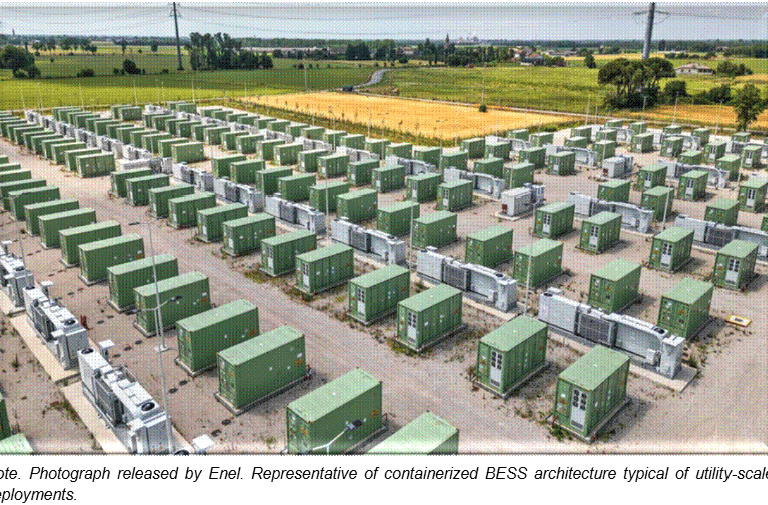
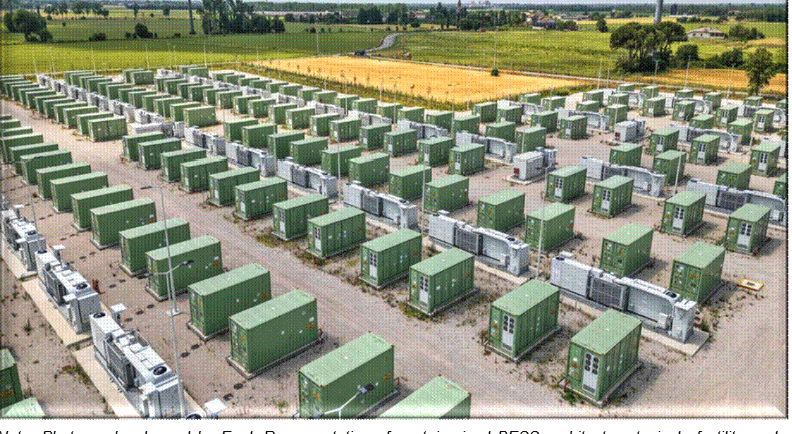
Figure 1. Battery Energy Storage System (BESS) in operation.
Note. Photograph released by Enel. Representative of containerized BESS architecture typical of utility-scale deployments.
RESULTADOS:
1. Avoided Network Costs
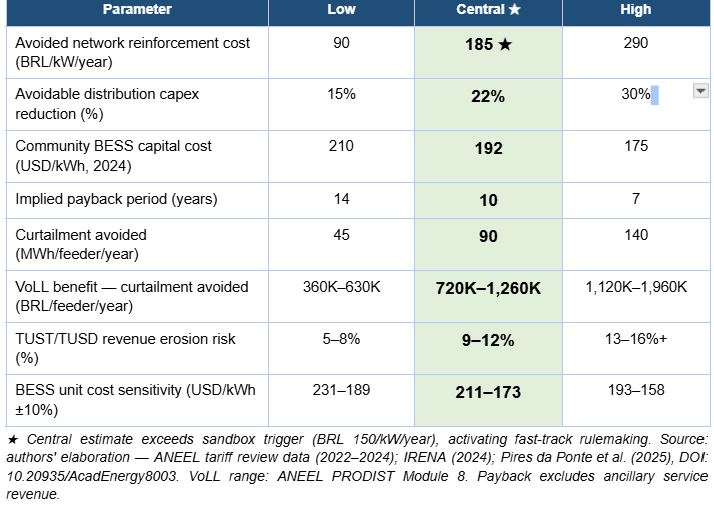
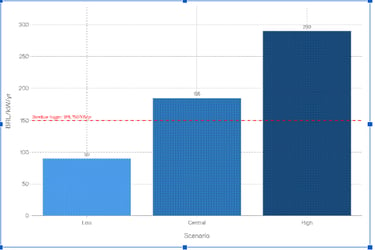
Preliminary cost-benefit estimates confirm the sandbox investment case. Central scenario: BRL 185/kW/year in avoided network reinforcement costs, 23% exceeding the proposed BRL 150/kW/year fast-track rulemaking trigger (ANEEL tariff review data 2022–2024; IRENA, 2024). The low scenario (BRL 90) does not activate rulemaking but produces the first operational community BESS dataset in Brazilian distribution grids.
Table 1. Preliminary Cost-Benefit Estimates — Community BESS in High-Penetration Solar Feeders (Southeast Brazil)
Parameter
Low
Central ★
High
★ Central estimate exceeds sandbox trigger (BRL 150/kW/year), activating fast-track rulemaking. Source: authors' elaboration — ANEEL tariff review data (2022–2024); IRENA (2024); Pires da Ponte et al. (2025), DOI: 10.20935/AcadEnergy8003. VoLL range: ANEEL PRODIST Module 8. Payback excludes ancillary service revenue.
2. Social Cost of Curtailment
The social benefit of avoided curtailment is equally compelling. At central scenario values, the Value of Lost Load reaches BRL 720,000–1,260,000 per feeder per year, substantially above avoided reinforcement costs alone. This exposes a structural failure: network costs are compensable, but curtailment losses are not. The sandbox makes both measurable, the precondition for making both compensable.
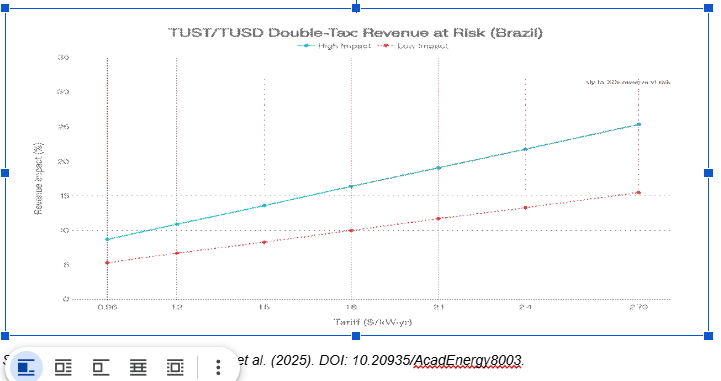
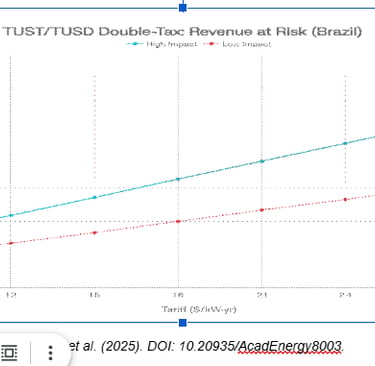
Figure 2 — TUST/TUSD double-tax impact on BESS annual revenue
Source: adapted from Pires da Ponte et al. (2025). DOI: 10.20935/AcadEnergy8003.
3. Tariff Barrier — Double TUST/TUSD
Double TUST/TUSD incidence erodes 16–32% of annual BESS revenue (Pires da Ponte et al., 2025), confirmed by USD 3.4 billion in curtailment losses across a single 212 MW wind farm in Ceará (2022–2024). No private capital absorbs that uncertainty without full risk pricing. The sandbox tariff waiver removes this barrier directly.
Figure 3 — Community BESS avoided costs vs. sandbox trigger — Southeast Brazil, three-scenario sensitivity
Note. Authors' elaboration based on ANEEL periodic tariff review data (2022–2024), IRENA BESS cost benchmarks (IRENA, 2024), and avoided cost methodology adapted from ARENA (2022) and Schittekatte & Meeus (2020). The trigger threshold (BRL 150/kW/yr) is a policy design parameter established by the authors. Central estimate (BRL 185/kW/yr) exceeds the trigger.
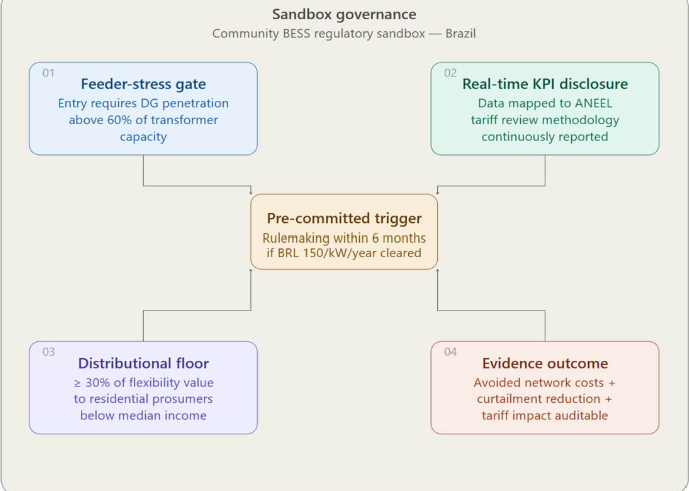
4. Sandbox Governance — Four Interlocking Pillars
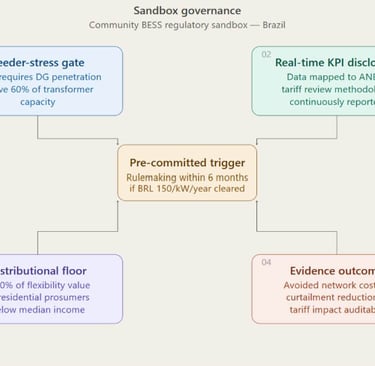
1) Entry gate: DG penetration above 60% of transformer capacity. 2) Data disclosure: real-time KPIs mapped to ANEEL tariff review methodology. 3) Trigger: fast-track rulemaking within six months if BRL 150/kW/year is cleared. 4) Distributional floor: ≥30% of flexibility value to residential prosumers below median income.
Figure 4 — Sandbox Governance – Four interlocking pillars
Source: Authors' elaboration based in tour article: Community BESS and the regulatory deadlock: a sandbox for Brazilian grids.
CONCLUSÃO:
Brazil has the solar resource, the industrial base, and since November 2025 the statutory framework. What it still lacks is the operational regulation that makes that framework investable. This sandbox converts inertia into evidence and evidence into rule. It ties a structured experiment, before it begins, to a specific policy commitment. If the evidence clears the threshold, rulemaking follows. That pre-commitment is what transforms a pilot into a durable rule and inertia into deployment at scale.
REFERÊNCIAS:
Brazil. (2025). Lei nº 15.269, de 25 de novembro de 2025. https://www.planalto.gov.br/ccivil_03/_Ato2023-2026/2025/Lei/L15269.htm
Empresa de Pesquisa Energética. (2021). Nota técnica: Sistemas de armazenamento de energia em baterias: Aplicações e questões relevantes para o planejamento. https://www.epe.gov.br/pt/publicacoes-dados-abertos/publicacoes/nt-sistemas-de-armazenamento-em-baterias-aplicacoes-e-questoes-relevantes-para-o-planejamento
Pires da Ponte, G., Rego, E. E., & Almeida Prado Júnior, F. A. (2025). Regulatory barriers to battery storage integration in Brazil: Moving beyond curtailment challenges. Academia Green Energy, 2. https://doi.org/10.20935/AcadEnergy8003
ARTIGO COMPLETO:
https://drive.google.com/open?id=1VVD7wmDCOPsIyRmw6Cgma9XpOi61jfw_